Snow Guards in Bozeman, MT
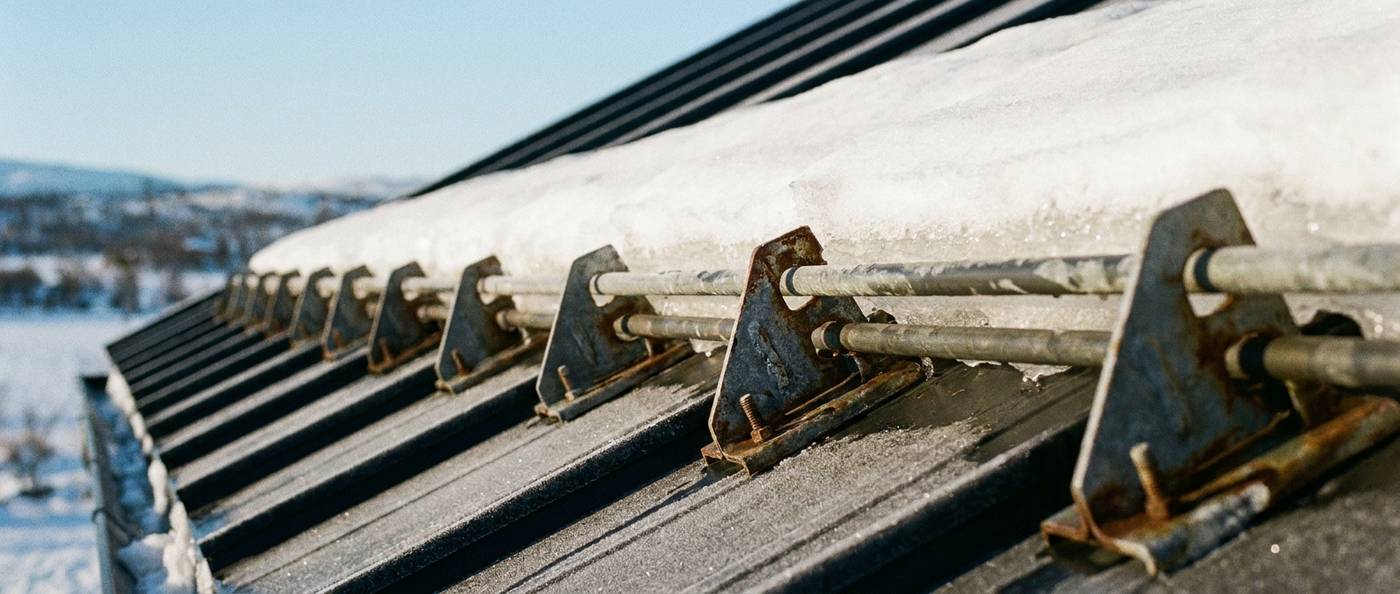
A snow guard holds the snowpack on the roof. That is the entire function. Instead of a roof releasing its whole winter load in one slide on the first warm afternoon, the snow stays put and melts off gradually. Where a roof sheds onto something that matters — a doorway, a walk, a drive, a gas meter, a heat pump, a deck, a neighbour's property — retention is the difference between a controlled melt and an avalanche.
Why Metal Roofs in Particular Need Snow Guards
Metal is common around the Gallatin Valley and it is very good at shedding snow, which is usually the reason people choose it. Standing-seam panels are slick, and once a lubricating film of meltwater forms between the panel and the snowpack, the entire load can release at once. A winter's accumulation coming off a two-storey roof carries real force, and it lands wherever gravity puts it.
What it lands on is the whole question. Snow shed can bury an exit, crush a deck rail or a shrub, take out a heat pump or an AC condenser, bend a gas meter or its regulator, and bury a furnace vent — which is a combustion-safety problem, not just an inconvenience. In town, where houses sit close together, it can also land on the neighbour's property, and that conversation is much easier to have before it happens.
The Types of Snow Guards
Pad or pronged snow guards — individual pieces set in a staggered pattern across the roof field. Common on shingle roofs, and unobtrusive.
Bar or fence systems — continuous rails running across the roof, usually in one or two rows above the eave. The stronger option for long runs and heavy loads.
Clamp-on for standing seam — guards that grip the seam itself with setscrews and never penetrate the panel. This is the preferred approach on standing-seam metal precisely because it creates no new holes in a watertight roof.
Snow Guard Layout Is the Whole Job
Snow guards are not decorative trim and they are not spaced by eye. The number and pattern depend on the roof pitch, the panel or shingle type, the length of the run from ridge to eave, and the design snow load for the site — which in Bozeman means starting from the city's published 41 psf roof snow load, and, outside the city, from what the building official sets for that site. Manufacturers publish layout calculations for exactly this reason.
The failure mode of an underspecified install is worth understanding: guards that are too few, too widely spaced or attached to inadequate substrate do not gently give way. They tear loose, taking roofing with them, and release the snow anyway — the same avalanche plus a roof repair. On shingle roofs, guards fastened through the roofing must be flashed and sealed properly or they become the leak they were meant to prevent.
Fitting Snow Guards to an Existing Roof
Retrofitting snow guards is usually straightforward, and best done in the warm months when the roof is clear and dry, sealants cure properly, and there is no snow to work around. If a roof dumped on your walk or your neighbour's drive last winter, summer is when to deal with it — not the following January.
One trade-off to go in with your eyes open about: a roof that now retains its snow is holding load rather than shedding it. That is the intended behaviour, and a properly framed roof is designed for it — see roof snow load. But it does mean a roof that used to self-clear may now benefit from occasional shoveling in a heavy winter.