Roof Heat Cable in Bozeman, MT
Heat cable does one job: it keeps a drainage channel open through the ice. It does not melt the snow off your roof and it does not stop ice forming at the eave. What it does is give meltwater a route off the roof instead of letting it pond behind a dam and back up under the shingles — which is the mechanism that actually damages houses.
That distinction matters because heat cable gets oversold. If your eaves ice up every single winter, the honest first conversation is about attic air-sealing, insulation and ventilation. Heat cable is what you fit when those are impractical — a cathedral ceiling with no accessible attic, complex roof geometry, a historic house you cannot rebuild from the inside, or a budget that will not stretch to the real fix this year.
Self-Regulating Cable
Modern self-regulating cable varies its output with temperature along its own length: colder sections draw more power, warmer sections idle down. That makes it more efficient than old constant-wattage tape and much more forgiving — it can cross over itself without creating a hot spot, which constant-wattage cable cannot. Run it through a thermostat or a snow-and-temperature controller so it works when conditions call for it rather than all winter.
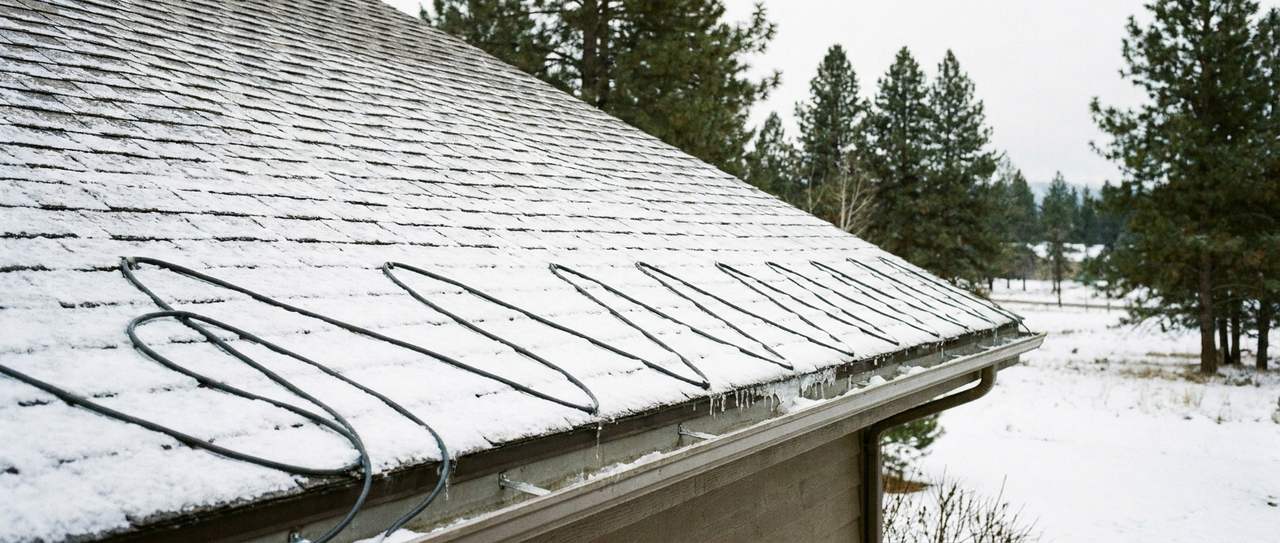
Where It Goes
The eave. A zigzag pattern across the overhang — the cold section that hangs beyond the heated wall below, where meltwater refreezes.
Valleys. Where two roof planes meet, meltwater from both concentrates into one channel. Valleys ice early and they are a common leak point.
Gutters and downspouts. The step that gets skipped, and skipping it wastes the whole install. A cleared eave draining into a frozen gutter and a solid downspout has still got nowhere to put the water. The cable has to run the full path to the ground.
Problem details. Around skylights and chimneys, where flashing already complicates drainage, and at roof-to-wall junctions where a lower roof meets a vertical wall.
Installed Before the Season
Autumn, before the first hard freeze. Fitting cable to a roof that is already iced means working around the very ice it was supposed to prevent, and the adhesive clips do not bond to a cold wet roof. If a particular eave dammed last winter, that is the one to point at in September — the same eave will dam again.
Bozeman's snow season runs from October into April, which sets the installation window firmly in early autumn. It also means cable left energised for the entire period is running for over half the year, which is the argument for putting it on a controller.
What It Does Not Do
It does not clear snow off a roof — see roof snow shoveling for load. It does not remove a dam that has already formed — that is steam. And it does not fix the heat loss that causes dams in the first place. Treat it as one part of a plan rather than the whole plan and it earns its keep.