Roof Snow Removal in Bozeman, Montana

Roof shoveling, snow load relief and ice dam steaming across Bozeman and the Gallatin Valley. Insured crews, storm-season availability, free estimates.

Call (406) 306-7031
Serving Bozeman, Belgrade, Four Corners, Gallatin Gateway, Big Sky & Livingston
Insured Crews
Emergency Service
Free Estimates
Steam Ice Dam Removal

Get a Roof Snow Removal Quote in Bozeman

Tell us what the roof is doing and we will get you a price. Faster by phone when snow is actively falling. Call (406) 306-7031.

  • Same-week scheduling through the season
  • Low-pressure steam — no chipping, no roof damage
  • Scheduled contracts for rentals and commercial roofs
  • Bozeman and the full Gallatin Valley

Roof Snow Removal Services in Bozeman

Every service below is roof work. If it involves snow or ice sitting on a structure in Bozeman, it is on this list — and each one has its own page.

Ice Dam Removal

Low-pressure steam that melts the dam off your eaves without touching the roofing.

Ice Dam Removal →

Roof Snow Shoveling

Hand clearing that takes weight off the structure before the next storm stacks on it.

Roof Snow Shoveling →

Roof Snow Load Checks

What Bozeman roofs are actually designed to carry, and how to tell when yours is over.

Roof Snow Load Checks →

Emergency Roof Snow & Ice

Active leak, sagging ceiling, or blocked egress — the calls that cannot wait for spring.

Emergency Roof Snow & Ice →

Heat Tape & Heat Cable

Self-regulating cable at the eaves and valleys so the dam never forms next winter.

Heat Tape & Heat Cable →

Snow Guards & Retention

Mechanical snow retention so a metal roof stops dumping its load on the front walk.

Snow Guards & Retention →

Commercial & Property Managers

Rentals, HOAs and commercial roofs — scheduled clearing and storm-triggered response.

Commercial & Property Managers →

Roof Snow Removal in Bozeman, MT

Bozeman Roof Snow Removal connects Bozeman homeowners, landlords and property managers with insured local crews for roof snow removal, roof shoveling and ice dam steaming. That is the whole business: getting snow and ice off Bozeman roofs before either one turns into a repair bill. Roof snow removal in Bozeman is not the same trade as plowing a driveway, and the difference shows up the first time somebody puts a steel shovel through a standing-seam panel.

The town of Bozeman averages roughly 54 inches of snow a year under the NOAA 1991–2020 climate normals. Snow starts landing in October and is still falling in April. That is seven months in which a roof somewhere in this valley is carrying more weight than its owner realises — and the valley floor figure understates the problem badly, because in Gallatin County the snow load depends far more on elevation than on the city limits.

When Roof Snow Removal Is Actually Needed in Bozeman

The City of Bozeman publishes its design criteria openly. For permits under the 2021 IRC and IBC, the city uses a ground snow load of 46 pounds per square foot and a roof snow load of 41 psf, with weathering classified as Severe and an ice barrier required under IRC Section R905.1.2. Those are real numbers from the people who issue the permits, and they mean a properly framed Bozeman roof is built for a serious winter.

What that number does not cover is the part that actually causes trouble: drifting. A design load assumes snow lands evenly. Real snow does not. It stacks behind dormers, piles where a steep roof dumps onto a lower one, loads up on the lee side after a wind event, and turns to ice at the eave after a few freeze-thaw cycles. Roof snow removal exists for the roofs and the winters where the even-load assumption stops being true.

So the honest framing is this: roof snow removal in Bozeman is not something every house needs every year. It is what you call for when the snow on a particular roof has stopped behaving the way the design assumed — and the sections below are how to tell.
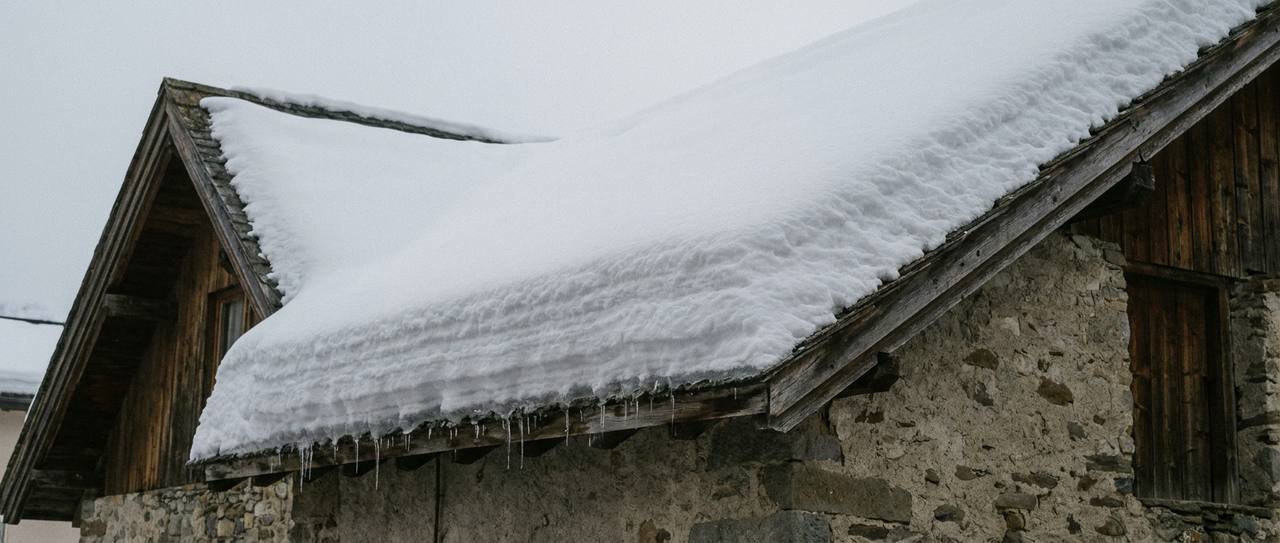
Elevation Sets the Load, Not the City Limits

This is the part almost nobody explains locally. Montana State University's snow load study for the state gives design ground snow loads station by station, and inside Gallatin County alone they run from 20.7 psf at Manhattan on the valley floor at 4,232 feet, to 33.3 psf at Belgrade Airport, to 42.3 psf at the Bozeman MSU station, to 95.7 psf at the Bozeman 12 NE station at 5,950 feet. That is more than a fourfold swing across one county.

Practically: a house on the flats toward Manhattan and a house up the bench toward Bridger Canyon are in completely different snow situations, even though both have Bozeman addresses on the mail. If you live higher, you carry more. The full station table and what it means for your roof is on the roof snow load page.

Ice Dam Removal in Bozeman

An ice dam forms when heat escaping the living space melts snow on the upper roof, the meltwater runs down to the cold eave, and refreezes there. The ridge of ice grows, backs water up under the shingles, and the water finds the inside of the house. Bozeman's building code anticipates exactly this — the city lists an ice barrier as required in its design criteria, the membrane that is supposed to keep backed-up water out of the structure.

That membrane is your insurance policy, not your solution. When water is already coming through the ceiling, the fix is low-pressure steam — delivered gently, cutting channels through the dam and lifting it off without touching the roofing. Chipping it off with hand tools destroys shingles and flashing, and the dam reforms within days because the heat loss that caused it is still there.

Older neighbourhoods near downtown produce a disproportionate share of these calls. The Cooper Park Historic District — 75 acres and roughly 250 homes, listed on the National Register in 1987 and largely 1930s bungalows with exposed rafters and deep front porches — is exactly the roof profile that dams: original eave details, decades of settled insulation, and heat finding its way out.

Who Calls Us for Roof Snow Removal

Four groups, roughly. Homeowners on low-slope or flat roofs, where nothing sheds on its own. Owners of older houses near downtown, where the ice forms at the eave every February whatever the snowfall does. Landlords, HOA boards and commercial owners, who carry roof snow as a liability and structural expense rather than a discretionary one — a large group in a town where most housing is rented. And anyone who has just watched a ceiling stain appear and wants somebody on it today.

If your roof is a steep-pitched metal roof built in the last twenty years and it sheds cleanly every storm, you may never need roof snow removal at all. We would rather say that plainly than sell you a service you do not need — though if it sheds onto a walkway, a gas meter or your neighbour's drive, that is what snow guards are for.

Snow on the Roof, Ice at the Eave, or Water Coming In?

Roof snow removal and ice dam steaming across Bozeman and the Gallatin Valley. Free estimates, and the fastest answer is always by phone.

(406) 306-7031

Roof Snow Removal in Bozeman — Common Questions

Who do I call to remove snow from my roof in Bozeman?

Call a crew that treats roof snow removal as its own trade, not as a sideline to plowing driveways. Roof work in Bozeman means fall protection, knowing which roofs shed and which hold their load, and never putting a steel shovel through a membrane or a standing-seam panel. Call (406) 306-7031 and we will match you with an insured local provider doing roof snow removal in Bozeman right now.

What is the snow load for a roof in Montana?

It depends on where in Montana, and in the Gallatin Valley it changes fast with elevation. Inside the city, the City of Bozeman publishes a design ground snow load of 46 pounds per square foot and a roof snow load of 41 psf for permits under the 2021 IRC and IBC. Statewide, Montana sets a floor: the minimum design roof snow load after allowed reductions is 30 psf unless a Montana-licensed design professional justifies otherwise. Outside the city limits the load is set by the building official rather than by one published number. Full detail on the roof snow load page.

Should I worry about roof snow load?

Your roof was engineered for a real Montana winter, so the honest answer is usually no. The trouble is that a design number describes the roof as framed and inspected — it says nothing about a drift stacking behind a dormer, a lower roof catching everything a higher roof sheds, a garage or addition framed to an older standard, or six weeks of freeze-thaw turning the bottom four feet into solid ice. Doors that suddenly stick, fresh cracks in drywall, or visible sag in a ridge mean stop guessing and get the weight off.

How much should roof snow removal cost?

Nationally, roof snow removal runs about $200 to $500 for a typical visit, or roughly $50 to $100 per hour, with $1,000 to $2,000 for large homes or difficult roof access. Ice dam steaming runs higher — commonly $800 to $2,400. Bozeman sits toward the upper end of those ranges because winter labour here is tight and access is often the hard part. See the cost page.

Can I just chip the ice off myself?

Please do not. Axes, hatchets, chisels and hammers are how shingles, flashing and gutters get destroyed, and a chipped ice dam grows straight back within days because the cause is still there. Low-pressure steam is the professional method precisely because it removes the ice without touching the roofing underneath.

Do people actually remove snow from roofs?

In the Gallatin Valley, routinely. It is normal maintenance on low-slope and flat roofs, on any roof where a drift builds in the same spot every year, and on older houses near downtown where the eaves ice up. Most steep-pitched roofs in town shed on their own and need nothing at all — which is worth saying plainly, because plenty of Bozeman roofs never need this service.

Can you service a rental or commercial building I do not live at?

Yes, and it is a large share of the work here. Bozeman is a renter-majority town with a lot of multifamily and student housing, and roof snow is a liability and structural expense for whoever owns the building. Scheduled clearing, storm-triggered response and coordination with a property manager are all normal — see commercial and property managers.

Do you serve the whole Gallatin Valley?

Bozeman, Belgrade, Four Corners, Gallatin Gateway, Manhattan and Three Forks, plus Big Sky and Livingston. Same crews and equipment; longer drive to the far ends.

Tap to Call — (406) 306-7031