Roof Snow Load in Bozeman, MT
The City of Bozeman publishes a design ground snow load of 46 pounds per square foot and a design roof snow load of 41 psf. Those figures come from the city's own building design criteria for permits under the 2021 IRC and 2021 IBC. If you have ever wondered what your Bozeman roof was built to carry, that is the number the engineer used.
The City of Bozeman's published design criteria
| Criterion | Value |
|---|---|
| Ground snow load (Pg) | 46 psf |
| Roof snow load (Pm) | 41 psf |
| Deck live (snow) load | 46 psf |
| Ice barrier (IRC R905.1.2) | Required |
| Weathering | Severe |
| Frost depth | 36 in. one storey / 48 in. two storey |
| Basic design wind speed | 115 mph (3-second gust) |
| Seismic design category | D0 (IRC) / D (IBC) |
| Codes adopted | 2021 IRC and 2021 IBC |
Source: City of Bozeman, Community Development — Building, Design Criteria. These are the figures used for permits inside the city limits.
Montana's Statewide Roof Snow Load Floor
Montana amends the model codes rather than adopting them unchanged. Under the state's administrative rules, snow loads "shall be determined by the building official," and outside certified city, county and town jurisdictions the design snow load is calculated using ASCE/SEI 7-22. The state sets a hard floor underneath all of it: the minimum design roof snow load after allowed reductions is 30 psf, unless a Montana-licensed design professional justifies a lower figure to the building official's satisfaction.
The practical consequence is that Bozeman is a certified jurisdiction with its own published numbers, while a site out in unincorporated Gallatin County has its design load set case by case. That is why this page gives you a figure for the city and a mechanism for everywhere else — anyone quoting you a single county-wide psf number is guessing.
Elevation Quadruples the Roof Snow Load Across One County
Montana State University's snow load study for the state publishes design ground snow loads station by station. The Gallatin County stations tell a striking story:
| Station | Elevation | Design ground snow load |
|---|---|---|
| Trident | 4,036 ft | 20.5 psf |
| Manhattan | 4,232 ft | 20.7 psf |
| Belgrade Airport | 4,427 ft | 33.3 psf |
| Bozeman 6 W Experiment Farm | 4,775 ft | 29.8 psf |
| Bozeman MSU | 4,913 ft | 42.3 psf |
| Bozeman 12 NE | 5,950 ft | 95.7 psf |
| Hebgen Dam | 6,489 ft | 137.1 psf |
| West Yellowstone | 6,659 ft | 135.0 psf |
Source: Snow Loads for Structural Design in Montana (revised 2004), Montana State University. These are measured station values from that study, not code figures — the code number for a given site inside the city is the City of Bozeman's 46 psf, and outside it the building official decides.
From about 20 psf on the valley floor near Manhattan to nearly 96 psf at 5,950 feet northeast of Bozeman — a more than fourfold swing inside a single county. Climb another thousand feet toward Hebgen and it doubles again.
What the Roof Snow Load Number Does Not Cover
A design snow load is an assumption about an evenly distributed load on a roof framed, inspected and maintained to that standard. Four common Gallatin Valley situations fall outside it:
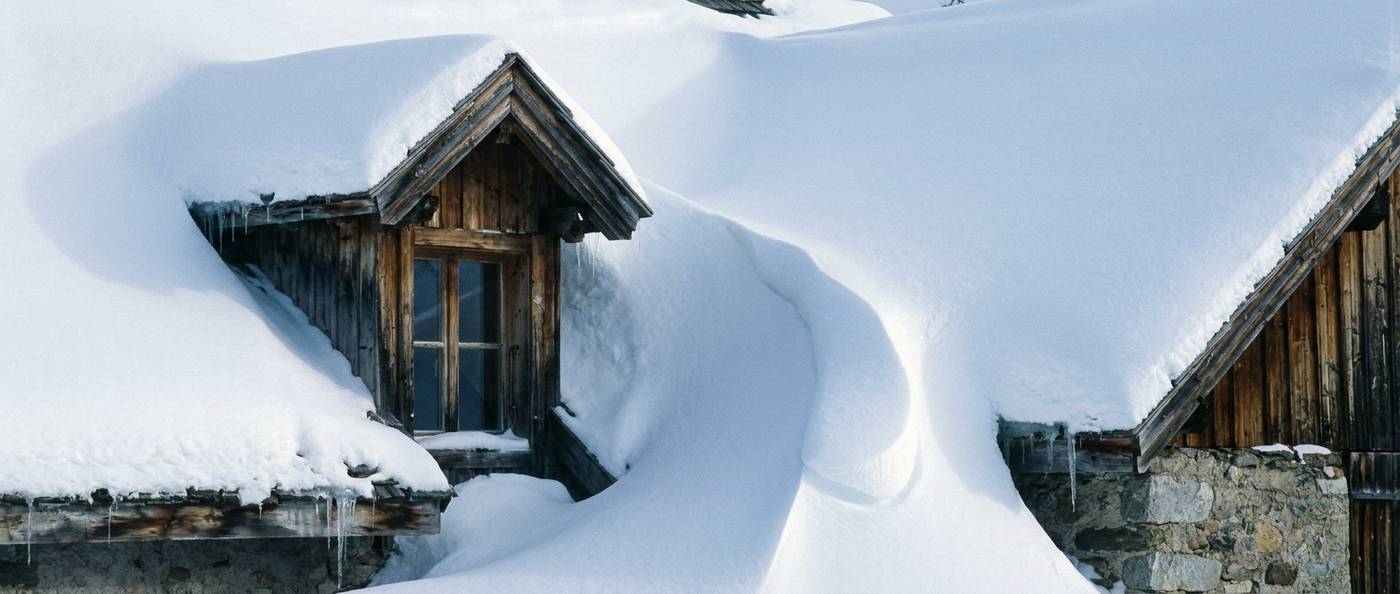
Drifting. Wind does not distribute snow evenly; it strips it from one surface and stacks it against the next obstruction. Behind a dormer, against a parapet, in a valley, in the lee of a taller wall. The concentrated load in a drift can be several times the flat-roof figure.
Sliding loads. A steep roof that sheds is not making the snow disappear — it is relocating it onto whatever is below. Garages, porches, additions and mud rooms take loads they were never designed to see.
Older and altered framing. An addition built to a previous code cycle, a converted outbuilding, or a house that has been re-roofed three times and is carrying the dead weight of layers nobody accounted for.
Rain on snow. A warm spell or rain event on a loaded roof adds weight fast, and a snowpack that has absorbed water and refrozen is dramatically heavier than the powder that fell.
Reading Roof Snow Load From Inside Your Own Building
Estimating load from the ground is unreliable, because density is the variable and you cannot see it. Read the structure instead. Interior doors that stick or stop latching. Fresh cracks in drywall or plaster, especially above door frames. Creaking or popping under load. A ridge line with a visible dip, or a ceiling that has stopped being flat. Any of those on a loaded roof is a reason to get the weight off first and investigate afterwards — that is what roof snow shoveling is for, and if a leak has already started, emergency service.
One honest caveat: most properly built Bozeman roofs handle a normal winter without any of this. The point of knowing the numbers is to recognise the minority of roofs and winters where the assumptions stop holding — not to worry about a well-framed house in an average February.